Practice by Topic: Algebra, Functions, Calculus, Vectors and Statistics
These IB Maths AA HL past paper questions worksheets give IB Maths Analysis and Approaches Higher Level students exam-style practice questions written in the format and difficulty of official IB past papers. Each topic below – from algebra and functions through to calculus, vectors, and statistics – has its own set of questions, so you can target exactly the area you’re revising rather than working through generic problem sets.
Every question is modelled on real AA HL past paper style and command terms, so what you practise here transfers directly to what you’ll see in your mocks and final exams. Full worked solutions are included with each worksheet, making them suitable for independent revision as well as classroom or tutoring use.
Topic 1: Number and Algebra
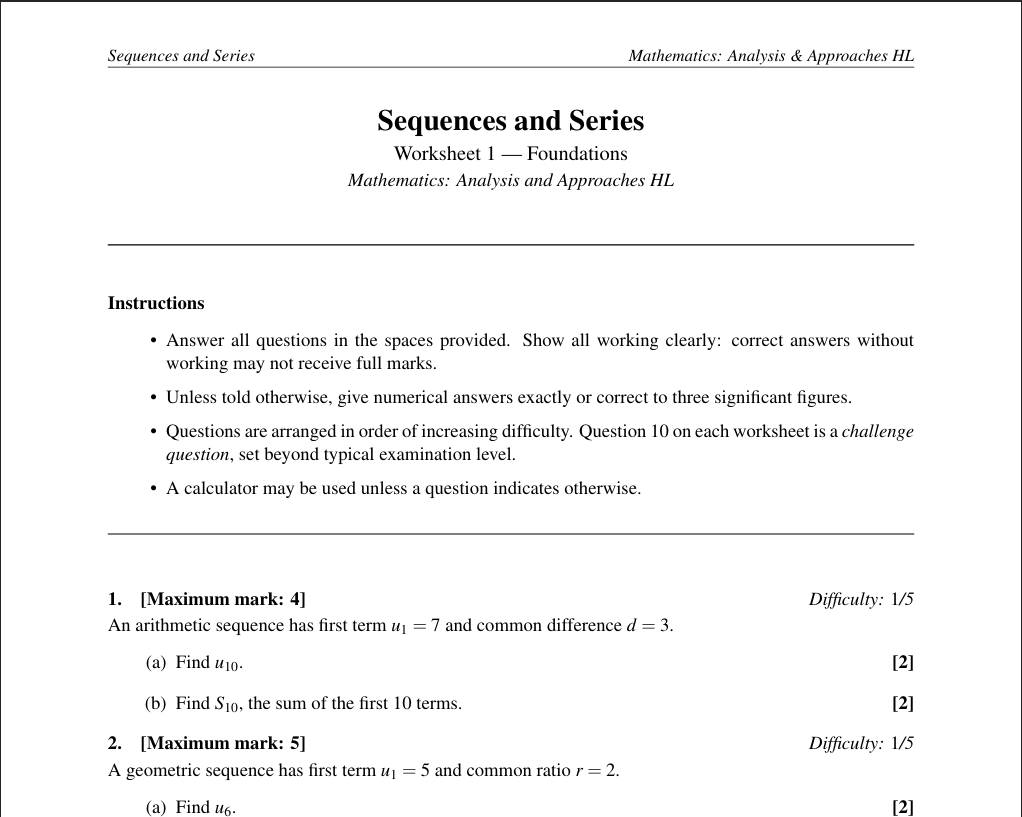
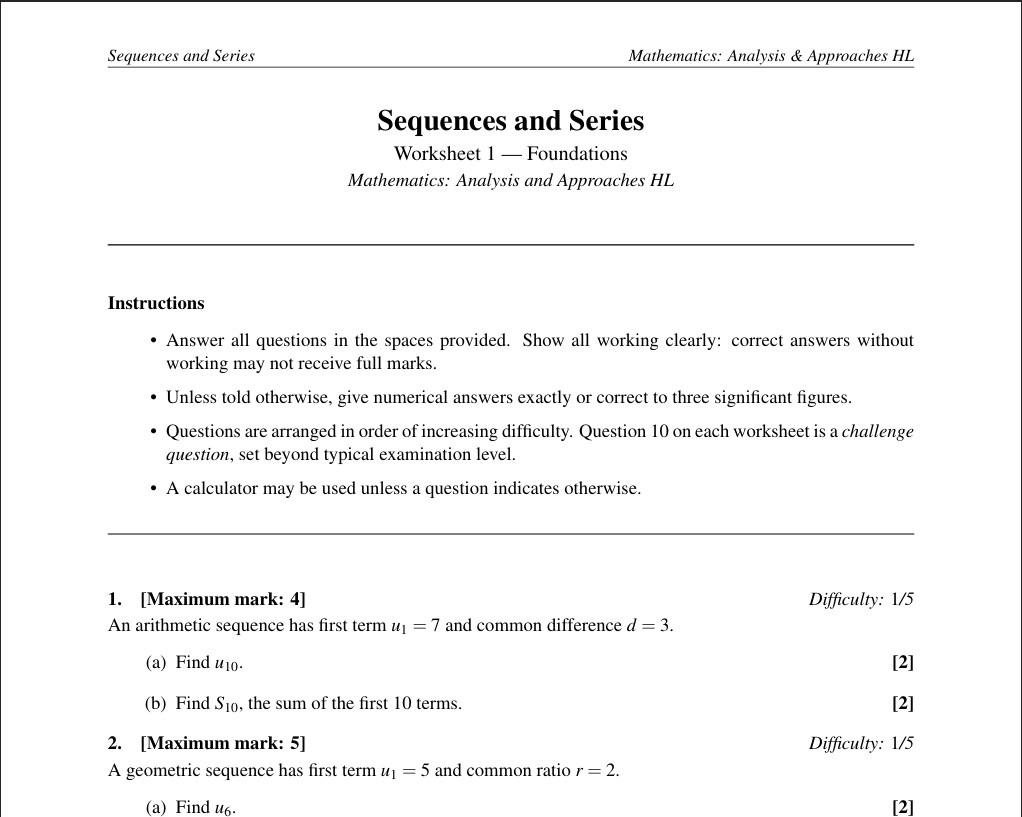
Sequences and Series
IB Maths AA HL past paper questions on number and algebra cover arithmetic and geometric sequences and series, sigma notation, and applications to compound interest and financial contexts — a core AA HL topic that appears in both Paper 1 and Paper 2. Worksheet A builds foundational fluency with formulas and notation, Worksheet B introduces multi-step problems and proof-by-induction style reasoning, and Worksheet C tackles the harder, multi-part exam questions that combine sequences with other topics.
- IB Maths HL AA Sequences and Series Worksheet A
- IB Maths HL AA Sequences and Series Worksheet B
- IB Maths HL AA Sequences and Series Worksheet C
Exponents and Logarithms
Focuses on the laws of exponents and logarithms, solving exponential and logarithmic equations, and the relationship between the two — a frequent source of algebraic slips under exam pressure. The three tiers move from straightforward law application through to equations requiring substitution or combined techniques, mirroring how IB past papers escalate difficulty within a single question.
- IB Maths HL AA Exponents and Logarithms Worksheet A
- IB Maths HL AA Exponents and Logarithms Worksheet B
- IB Maths HL AA Exponents and Logarithms Worksheet C
Binomial Theorem
Practises expansions using the binomial theorem, including questions involving negative and fractional indices, which HL students need but SL students don’t. Worksheets progress from direct expansions to problems requiring you to extract specific terms or coefficients — a common command-term style in past papers.
- IB Maths HL AA Binomial Theorem Worksheet A
- IB Maths HL AA Binomial Theorem Worksheet B
- IB Maths HL AA Binomial Theorem Worksheet C
Mathematical Proofs
Builds the proof techniques AA HL explicitly examines: direct proof, proof by contradiction, and proof by induction. Because proof questions are marked heavily on rigour and correct notation rather than just a correct final answer, these worksheets are designed to train the structure of a full-marks answer, not just the underlying maths.
- IB Maths HL AA Mathematical Proofs Worksheet A
- IB Maths HL AA Mathematical Proofs Worksheet B
- IB Maths HL AA Mathematical Proofs Worksheet C
Complex Numbers
IB Maths AA HL past paper questions on complex numbers cover Cartesian, polar, and Euler form, operations with complex numbers, and their geometric interpretation on the Argand diagram. The worksheets move from core algebraic manipulation to the more demanding HL-only content, such as roots of complex numbers and De Moivre’s theorem.
- IB Maths HL AA Complex Numbers Worksheet A
- IB Maths HL AA Complex Numbers Worksheet B
- IB Maths HL AA Complex Numbers Worksheet C
Counting Principles
IB Maths AA HL past paper questions help you practice permutations, combinations, and the counting techniques that underpin probability questions elsewhere on the exam. Later worksheets introduce the multi-step reasoning IB examiners favour, where a single question combines counting principles with constraints or conditions.
- IB Maths HL AA Counting Principles Worksheet A
- IB Maths HL AA Counting Principles Worksheet B
- IB Maths HL AA Counting Principles Worksheet C
Topic 2: Functions
Functions
IB Maths AA HL past paper questions on functions cover function notation, composite and inverse functions, domain and range, and transformations — foundational content that reappears throughout the AA syllabus. The three tiers build from identifying and describing functions to the more analytical, multi-part questions typical of Paper 1.
- IB Maths HL AA Functions Worksheet A
- IB Maths HL AA Functions Worksheet B
- IB Maths HL AA Functions Worksheet C
Rational Functions
Focuses on graphing and analysing rational functions, including asymptotes, discontinuities, and their algebraic behaviour — a topic IB examiners often pair with calculus questions later in the course. Worksheets progress from sketching and interpretation to full algebraic analysis of more complex rational expressions.
- IB Maths HL AA Rational Functions Worksheet A
- IB Maths HL AA Rational Functions Worksheet B
- IB Maths HL AA Rational Functions Worksheet C
Topic 3: Geometry and Trigonometry
Geometry
Covers coordinate and 3D geometry, including angles, distances, and volumes — the non-vector geometry content tested on AA HL Paper 1 and 2. Questions move from direct application of formulas to the multi-step spatial reasoning problems that typically appear in the final section of a paper.
- IB Maths HL AA Geometry Worksheet A
- IB Maths HL AA Geometry Worksheet B
- IB Maths HL AA Geometry Worksheet C
Vectors and Planes
Practises vector algebra, equations of lines and planes, and the intersections and angles between them — HL-specific content that SL students don’t cover. The worksheets build from core vector operations to the harder 3D problems involving planes, which are a common source of lost marks in real exams.
- IB Maths HL AA Vectors and Planes Worksheet A
- IB Maths HL AA Vectors and Planes Worksheet B
- IB Maths HL AA Vectors and Planes Worksheet C
Trigonometric Functions
IB Maths AA HL past paper questions cover the graphs, transformations, and identities of trigonometric functions, along with solving trigonometric equations over a given domain. Later worksheets introduce the more intricate identity manipulation and equation-solving that HL papers use to differentiate top-band answers.
- IB Maths HL AA Trigonometric Functions Worksheet A
- IB Maths HL AA Trigonometric Functions Worksheet B
- IB Maths HL AA Trigonometric Functions Worksheet C
Trigonometry
Focuses on non-right-angle trigonometry — the sine rule, cosine rule, and area of a triangle — along with their application to real-world and exam-style contexts. Worksheets progress from direct formula application to multi-step problems combining trigonometry with geometry or vectors.
- IB Maths HL AA Trigonometry Worksheet A
- IB Maths HL AA Trigonometry Worksheet B
- IB Maths HL AA Trigonometry Worksheet C
Topic 4: Statistics and Probability
Probability
IB Maths AA HL past paper questions on statistics and probability covers conditional probability, tree and Venn diagrams, combined events, and expected value — foundational content that also underpins later distribution questions. Worksheets progress from direct calculation to the layered, multi-event problems that IB examiners use to test whether students can select the right approach under exam conditions.
- IB Maths HL AA Probability Worksheet A
- IB Maths HL AA Probability Worksheet B
- IB Maths HL AA Probability Worksheet C
Normal Distribution
Focuses on using the normal distribution to find probabilities and boundary values, including inverse normal calculations and standardisation — a topic that’s easy to lose marks on through calculator or notation errors alone. The worksheets build from straightforward probability lookups to the harder “find the unknown mean or standard deviation” style questions common on Paper 2.
- IB Maths HL AA Normal Distribution Worksheet A
- IB Maths HL AA Normal Distribution Worksheet B
- IB Maths HL AA Normal Distribution Worksheet C
Topic 5: Calculus
Differentiation
IB Maths AA HL past paper questions on differentiation cover differentiation rules including chain, product, and quotient rules, along with applications to gradients, tangents, and stationary points. Later worksheets move into the HL-specific content — implicit differentiation and related rates — that distinguishes AA HL from SL and frequently appears in the harder parts of Paper 1.
- IB Maths HL AA Differentiation Worksheet A
- IB Maths HL AA Differentiation Worksheet B
- IB Maths HL AA Differentiation Worksheet C
Integration
Practises integration techniques including substitution and integration by parts, along with definite integrals and applications to area and volume. The three tiers build from direct application of standard techniques to the multi-step problems that combine integration with area-between-curves or volume-of-revolution questions.
- IB Maths HL AA Integration Worksheet A
- IB Maths HL AA Integration Worksheet B
- IB Maths HL AA Integration Worksheet C
Differential Equations
Covers setting up and solving first-order differential equations, including separation of variables — HL-only content that often appears combined with a real-world modelling context. Worksheets progress from technique-focused questions to the applied, multi-part problems where students must first translate a written scenario into an equation.
- IB Maths HL AA Differential Equations Worksheet A
- IB Maths HL AA Differential Equations Worksheet B
- IB Maths HL AA Differential Equations Worksheet C
Kinematics
IB Maths AA HL past paper questions on kinematics focus on the calculus of motion — displacement, velocity, and acceleration functions and the relationships between them via differentiation and integration. The worksheets move from direct application of these relationships to the more demanding problems requiring students to interpret motion graphs or reconstruct one function from another.
- IB Maths HL AA Kinematics Worksheet A
- IB Maths HL AA Kinematics Worksheet B
- IB Maths HL AA Kinematics Worksheet C
Maclaurin Series
Covers deriving and using Maclaurin series to approximate functions, including standard series for common functions and their radius of convergence — one of the more abstract HL-only topics. Later worksheets introduce the harder applications, such as using series to approximate limits or combining multiple series expansions.
- IB Maths HL AA Maclaurin Series Worksheet A
- IB Maths HL AA Maclaurin Series Worksheet B
- IB Maths HL AA Maclaurin Series Worksheet C
How These IB Maths AA HL Past Paper Questions Worksheets Are Structured
Each IB Maths AA HL past paper questions worksheet follows the question style, mark allocation, and
command terms used in official IB AA HL papers, so students build
familiarity with exam phrasing alongside the underlying maths.
Worked solutions let you check method as well as final answers,
which matters for HL papers where method marks carry real weight.
New worksheets are added as topics are completed, so check back if
you can’t find a specific topic yet.
Are these worksheets free to download?
Yes, all IB Maths AA HL worksheets on this page are free to download as PDFs. No sign-up or payment is required.
Do the worksheets match the current IB AA HL syllabus?
Yes, every worksheet is written to the current IB Mathematics Analysis and Approaches Higher Level syllabus, covering the same topics and skills assessed in official IB exams.
Are worked solutions included?
Yes, each worksheet comes with full worked solutions, not just final answers, so you can check your method as well as your result.
How difficult are these worksheets compared to the real exam?
The questions are written in the style and difficulty of official IB AA HL past papers, using the same command terms and mark allocations you’ll see in your actual exams.
Can I use these worksheets for classroom teaching or tutoring, not just self-study?
Yes, the worksheets are suitable for independent revision, classroom use, and one-to-one tutoring.
Which topics are covered?
Worksheets are available across all AA HL syllabus topics, including algebra, functions, calculus, vectors, statistics and probability, and more. New worksheets are added as they’re completed.
Do I need a calculator for these worksheets?
The worksheets are currently mixed, some questions will require a calculator to complete and you may use a calculator unless a question specifies otherwise.

Mark is an A-Level Economics tutor who has been teaching for 6 years. He holds a masters degree with distinction from the London School of Economics and an undergraduate degree from the University of Edinburgh.