This page compiles all Edexcel A-Level Economics past paper questions from Theme 2 in one place, allowing you to revise core macroeconomics topics without searching through dozens of past papers.
Theme 2 forms the foundation of macroeconomics in the Edexcel specification and focuses on how the UK economy operates at a national level. Questions in this theme test your understanding of aggregate demand and supply, inflation, output gaps, the multiplier, and the use of fiscal and monetary policy. These concepts appear repeatedly across Paper 2 and Paper 3, often forming the analytical backbone of longer evaluation questions.
How to use Theme 2 questions effectively in revision
A strong revision strategy is to practise Theme 2 questions by sub-topic, rather than in chronological order. For example, you might focus first on multiplier and circular flow questions, then move on to inflation and real incomes, before tackling broader evaluation questions involving macroeconomic trade-offs.
If you want to practise how Theme 2 content is examined in longer evaluative formats, these questions pair well with Edexcel A-Level Economics 12-marker questions, where macroeconomic objectives and policy conflicts are tested in more depth.
What Theme 2 prepares you for later in the course
Theme 2 provides the analytical framework that is later extended in Theme 4, where similar macroeconomic tools are applied to the global economy. Understanding concepts like output gaps, demand-side policy, and supply-side reform at a UK level makes it much easier to evaluate international macroeconomic issues later in the course.
Many Theme 2 questions also overlap directly with trade-offs between macroeconomic objectives, especially when analysing inflation, unemployment, growth, and fiscal balance.
Organising Theme 2 alongside other macro topics
If you are structuring your revision by specification theme, you may also find it useful to practise questions grouped by question style rather than content. For example, combining Theme 2 study with targeted 8-marker practice can help improve speed and analytical clarity before attempting longer answers.
Question 1: Edexcel A-Level Economics 9EC0 Paper 2 November 2021
It has been estimated that if climate change led to the world’s temperature rising 2.5 °C compared to the temperature in 2010, then global GDP per capita would be 15% lower by 2100. If temperatures rise by 4 °C compared to the temperature in 2010, then by 2100 global GDP per capita would decline by more than 30%.
Evaluate the potential trade-offs between environmental protection and other macroeconomic objectives. (25 points)
Question 2: Edexcel A-Level Economics 9ECO Paper 2 June 2018

Extract A
UK companies use forward currency market
The Norfolk-based picture frames maker Nielsen Bainbridge recently made forward contracts in the foreign exchange market to reduce the impact of currency fluctuations. The pound’s post-Brexit referendum depreciation has been a test of nerve for Nielsen Bainbridge and many other importers. At present the company’s suppliers are located in Europe or China. “Currency therefore has a big impact on our business and the margins we can obtain,” says Ms Burdett, the Finance Director. Forward contracts enable institutions, businesses and individuals to lock in an exchange rate over a certain period of time regardless of how the rate moves during that time. Ms Burdett buys currency as soon as Nielsen Bainbridge confirms a large order as a way to fix costs. One third of UK business managers are considering shifting from EU to UK suppliers.
Extract B
Bank of England seeking to prevent future bank bailouts
The Bank of England has ordered big lenders in the UK to find £116 billion of funding to ensure that taxpayers will never again have to bail out the banking sector. The Bank intends to publish details of how each of the big lenders would cope in the event they find themselves in a situation similar to Royal Bank of Scotland and Lloyds Banking Group, which needed £65 billion of taxpayer bailouts during the 2008 Global Financial Crisis. This had a significant negative impact on the UK government’s national debt and, many would argue, increased the need for contractionary fiscal policy. Having said that, the UK government sold all its shares in Lloyds Banking Group in 2017 and, according to the Chancellor of the Exchequer, “recovered every penny of its investment in Lloyds”. Sir Jon Cunliffe, the deputy governor at the Bank responsible for financial stability, said regulators needed to let banks fail in a similar way that traditional companies collapse. This has not been possible in the past because of the risk that savers lose their money and because a system did not exist to allow banks to be put into insolvency. “Just like when other businesses fail, losses arising from bank failure would be imposed on shareholders and investors. This protects the public from loss and incentivises banks to operate more prudently,” said Cunliffe.
Extract C
Bank of England tells lenders to increase capital reserves
The Bank of England has told lenders they will need to build a special reserve worth £11.4 billion by the end of 2018 as it tries to make banks more resilient to the risk posed by mounting consumer debt. This reserve of assets that can be readily turned into cash is a way of forcing banks to set aside capital reserves in good times in order to keep lending to the wider economy at a steady level, even during an economic downturn. In 2017 the Bank of England told UK banks it would raise the reserve ratio, relative to all assets, from zero to 0.5% and also forecast a further increase to 1% by the end of 2017. The move is not intended to directly reduce consumer demand for credit, which in 2017 grew by 10.3% on an annual basis, but it may well lead to banks becoming less willing to lend to consumers. Since the Bank of England has recently become increasingly concerned about consumer borrowing, including rising car loans and credit card debt, this may be no bad thing as far as the Bank of England is concerned, even if it does have a negative impact on the wider economy.
Analysts are concerned about the impact on consumer confidence of rising inflation, partly caused by a falling pound. With falling real incomes consumers could become more vulnerable to falling behind with their credit card and personal loan repayments. Despite these concerns, the UK economy recently recorded the lowest rate of unemployment since 1975.
(a) With reference to Extract A, explain the role of forward markets in currencies. (5 points)
(b) With reference to Extract A and Figure 1, examine the likely impact of the change in the sterling exchange rate on the UK economy. (8 points)
(c) With reference to the last paragraph in Extract C, assess the impact of a fall in real incomes on subjective happiness. (10 points)
(d) With reference to Extract C, discuss the potential conflicts between macroeconomic objectives when the central bank attempts to control inflation. (12 points)
(e) Discuss whether providing substantial government financial support to banks is the best policy response during a financial crisis. (15 points)
Question 3: Edexcel A-Level Economics 9EC0 November 2021 Paper 2
After the Global Financial Crisis of 2008, the US President introduced expansionary fiscal policies of $800 billion. The International Monetary Fund estimated that the multiplier at the time was approximately 1.5.
(a) Which one of the following is a withdrawal from the circular flow of income? (1 points)
A Exports
B Government spending
C Investment
D Taxation
(b) Calculate the total final increase in US aggregate demand as a result of the President’s ‘expansionary fiscal policies’, assuming no other changes. (2 points)
(c) Explain the impact of annual fiscal deficits on the US national debt. (2 points)
Question 4: Edexcel A-Level Economics 9EC0 June 2017 Paper 2
The table below shows the marginal propensity to save data for an economy.
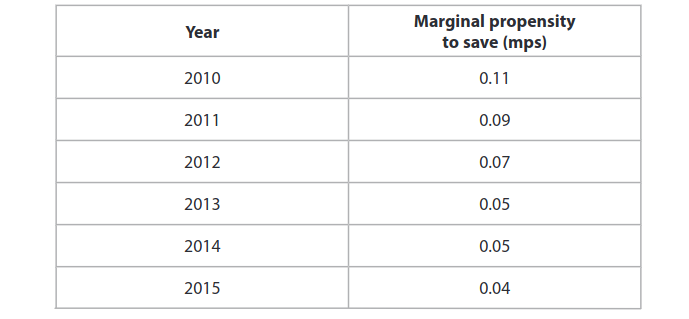
(a) Explain one possible reason for the changes in the marginal propensity to save as shown in the table.
(b) Explain the likely effect of a fall in the marginal propensity to save on the value of the multiplier if other things remain equal.
An economy has a marginal propensity to save of 0.1, a marginal propensity to tax of 0.2 and marginal propensity to import of 0.1.
(c) Which one of the following is the correct size of the multiplier? (1 point)
A 0.4
B 0.6
C 1.7
D 2.5

Mark is an A-Level Economics tutor who has been teaching for 6 years. He holds a masters degree with distinction from the London School of Economics and an undergraduate degree from the University of Edinburgh.