This article contains a curated list of Edexcel A-Level Economics past paper questions on the multiplier. These questions have been gathered to help you revise how changes in government spending, investment, and consumption can lead to larger changes in national income, without needing to search through dozens of Edexcel papers.
If you’re revising other macroeconomic topics, you can browse the full collection of Edexcel A-Level Economics past paper questions here.
What is the Edexcel A-Level Economics course?
The Edexcel A-Level Economics course is a qualification taken by students in the final two years of secondary school study. It is designed to prepare students for further study in economics or related subjects at university.
Pearson Edexcel is the UK’s largest examinations board and offers one of the most widely taken A-Level Economics specifications. Alternative exam boards include AQA, OCR, Eduqas, and CIE.
Where did we get these Edexcel Economics A-Level multiplier questions?
We identified these multiplier questions by reviewing all available Edexcel A-Level Economics past papers under the current specification. Every question included here directly tests students’ understanding of the multiplier mechanism, leakages, and fiscal policy.
This page is intended as a focused revision tool, allowing you to practise multiplier questions in one place rather than searching through multiple exam papers.
What is Keynesian economics?
Keynesian economics is the school of thought developed by John Maynard Keynes, which argues that government intervention can be used to stabilise the economy.
Keynesian economists believe that during periods of weak demand or recession, governments can stimulate economic growth through:
- Increased government spending
- Expansionary fiscal policy
- Loose monetary policy
This approach contrasts with laissez-faire economics, which argues that markets self-correct and that government intervention is often ineffective or inflationary.
Keynesian theory underpins much of Edexcel’s treatment of fiscal policy, demand management, and the multiplier, and is frequently assessed alongside questions on recession and financial crises.
What is the multiplier?
The multiplier refers to the process by which an initial increase in spending leads to a larger overall increase in national income (GDP).
For example, when the government increases spending:
- Income rises for workers and firms
- A portion of that income is spent on consumption
- That spending becomes income for others
- The process repeats
As a result, the final increase in GDP is greater than the initial injection of spending.
The size of the multiplier depends on leakages from the circular flow of income, such as:
- Saving
- Taxation
- Imports
Because of this, multiplier questions are closely linked to:
- Fiscal policy
- Aggregate demand
- Macroeconomic objectives such as growth and employment
To strengthen your revision, it’s useful to practise trade-offs between macroeconomic objectives, where multiplier effects often feature.
Multiplier questions also commonly overlap with labour-market effects, especially unemployment during downturns.
Question 1: Edexcel A-Level Economics 9EC0 November 2021 Paper 2
After the Global Financial Crisis of 2008, the US President introduced expansionary fiscal policies of $800 billion. The International Monetary Fund estimated that the multiplier at the time was approximately 1.5.
(a) Which one of the following is a withdrawal from the circular flow of income? (1 points)
A Exports
B Government spending
C Investment
D Taxation
(b) Calculate the total final increase in US aggregate demand as a result of the President’s ‘expansionary fiscal policies’, assuming no other changes. (2 points)
(c) Explain the impact of annual fiscal deficits on the US national debt. (2 points)
Question 2: Edexcel A-Level Economics 9EC0 June 2017 Paper 2
The table below shows the marginal propensity to save data for an economy.
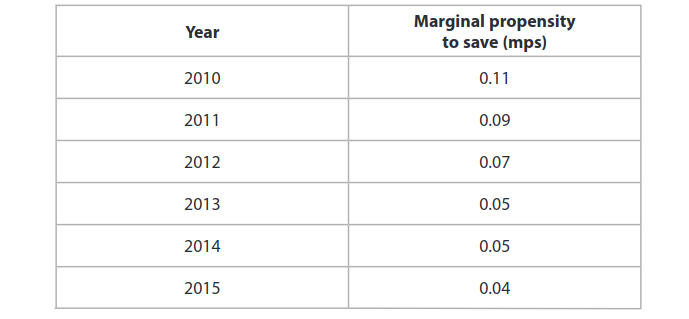
(a) Explain one possible reason for the changes in the marginal propensity to save as shown in the table.
(b) Explain the likely effect of a fall in the marginal propensity to save on the value of the multiplier if other things remain equal.
An economy has a marginal propensity to save of 0.1, a marginal propensity to tax of 0.2 and marginal propensity to import of 0.1.
(c) Which one of the following is the correct size of the multiplier? (1 point)
A 0.4
B 0.6
C 1.7
D 2.5
D 2.5

Mark is an A-Level Economics tutor who has been teaching for 6 years. He holds a masters degree with distinction from the London School of Economics and an undergraduate degree from the University of Edinburgh.