This page brings together Edexcel A-Level Economics past paper questions on trade, exchange rates, and purchasing power parity (PPP). All questions have been selected from official Edexcel papers and organised to help students revise key international economics concepts efficiently, without needing to search through multiple exam papers.
These questions are particularly relevant for students revising international competitiveness, exchange rate movements, and trade performance, which feature heavily across Edexcel Paper 2 and Paper 3.
What is the Edexcel A-Level Economics course?
Edexcel A-Level Economics is a qualification taken by students in the final two years of secondary education in the UK. The course is designed to prepare students for university-level study in economics and related disciplines by developing analytical, quantitative, and evaluative skills.
The qualification is offered by Pearson Edexcel, the UK’s largest examination board. Alternative A-Level Economics specifications are offered by exam boards such as AQA, OCR, Eduqas, and Cambridge International, but this page focuses exclusively on Edexcel-set questions.
Where did we get these Edexcel A-Level Purchasing Power Parity questions?
The questions on this page were compiled by reviewing all publicly available Edexcel A-Level Economics past papers under the current specification. We identified every question that directly or indirectly tests purchasing power parity, exchange rates, trade competitiveness, or currency movements, and assembled them into a single revision resource.
This allows students to practise exam-style questions on international economics in one place, rather than searching across multiple past papers.
If you are revising other parts of the specification, you can find a full topic index here.
What is Purchasing Power Parity (PPP)?
Purchasing power parity (PPP) is a method used to compare the value of different currencies by examining the cost of a standard “basket of goods” in each country. Rather than relying on market exchange rates alone, PPP adjusts for differences in price levels and cost of living between countries.
For example, while the market exchange rate might suggest that £1 is worth roughly 1,000 Indian rupees, this does not reflect what that money can actually buy. A basic lunch costing £5 in the UK may cost around 300 rupees in India, meaning that £5 converted into rupees would purchase many more goods. In this sense, the pound has greater purchasing power in India than in the UK.
Because market exchange rates are influenced by speculation, capital flows, and investor confidence, economists often use PPP when comparing GDP per capita, living standards, and productivity across countries.
Students frequently encounter PPP in questions on international comparisons of GDP and productivity, particularly in Paper 2 data response questions.
What is an exchange rate?
An exchange rate is the price of one currency expressed in terms of another. For example, if £1 can be exchanged for $1.60, the exchange rate is 1:1.6.
Exchange rates are determined by supply and demand in foreign exchange markets and can fluctuate due to factors such as:
- changes in trade balances
- capital flows and foreign investment
- interest rate differentials
- expectations and investor confidence
For instance, announcements that reduce confidence in a country’s economic stability can lead investors to sell its currency, causing depreciation even without any immediate policy change.
Exchange rate movements have significant implications for exports, imports, inflation, and economic growth, making them central to Edexcel questions on trade performance and macroeconomic objectives.
If you are revising related topics, you may also find it useful to practise questions on:
Market responses to currency changes (Edexcel A-Level Economics Past Paper Questions on Market Structures)
Macroeconomic objectives and trade-offs (Edexcel A-Level Past Paper Questions on Trade-Offs Between Macroeconomic Objectives)
Question 1: Edexcel A-Level Economics 9EC0 November 2021 Paper 2
GDP at Purchasing Power Parities, Germany and France (nominal, trillions of US dollars) 2010–2017.
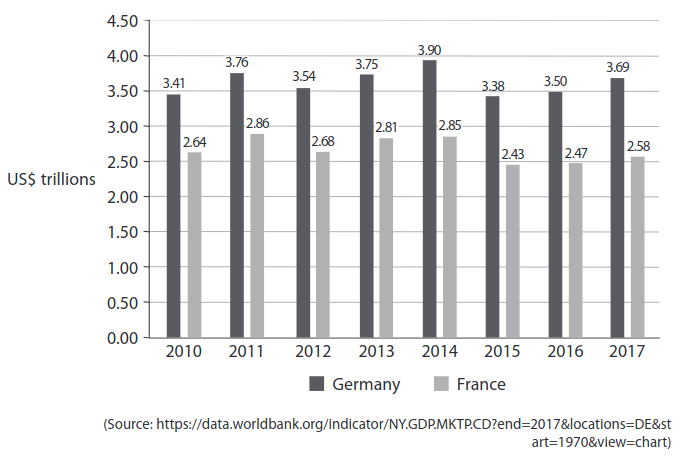
(a) From the data in the graph above, which one of the following may be deduced? (1 point)
A France’s rate of inflation was lower than Germany’s in 2017
B Germany’s GDP is smaller than France’s in every year shown
C In every year that France’s GDP fell compared to the previous year, Germany’s GDP did too
D The GDP of both Germany and France fell between 2015 and 2016
(b) Calculate the percentage change in Germany’s nominal GDP from 2016 to 2017. (2 points)
(c) Explain one reason why Purchasing Power Parities are used. (2 points)
Question 2: Edexcel A-Level Economics May 2019 Paper 2
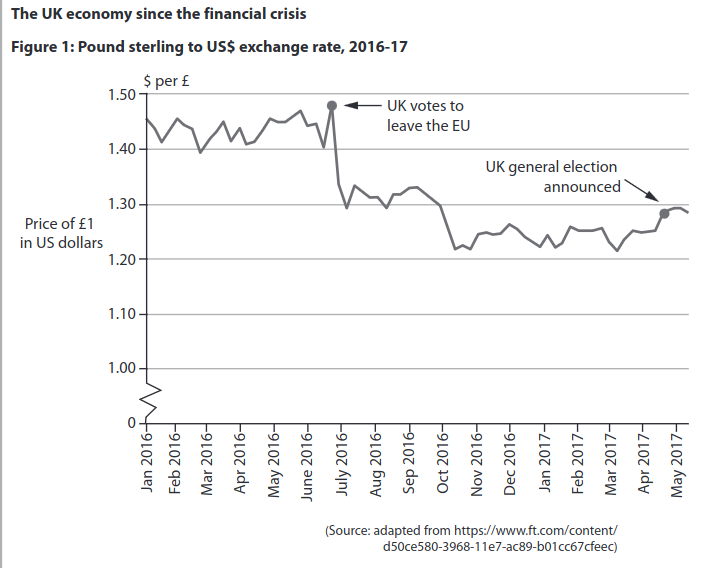
Extract A
UK companies use forward currency market
The Norfolk-based picture frames maker Nielsen Bainbridge recently made forward contracts in the foreign exchange market to reduce the impact of currency fluctuations. The pound’s post-Brexit referendum depreciation has been a test of nerve for Nielsen Bainbridge and many other importers. At present the company’s suppliers are located in Europe or China. “Currency therefore has a big impact on our business and the margins we can obtain,” says Ms Burdett, the Finance Director. Forward contracts enable institutions, businesses and individuals to lock in an exchange rate over a certain period of time regardless of how the rate moves during that time. Ms Burdett buys currency as soon as Nielsen Bainbridge confirms a large order as a way to fix costs. One-third of UK business managers are considering shifting from EU to UK suppliers.
Extract B
Bank of England seeking to prevent future bank bailouts
The Bank of England has ordered big lenders in the UK to find £116 billion of funding to ensure that taxpayers will never again have to bail out the banking sector. The Bank intends to publish details of how each of the big lenders would cope in the event they find themselves in a situation similar to Royal Bank of Scotland and Lloyds Banking Group, which needed £65 billion of taxpayer bailouts during the 2008 Global Financial Crisis. This had a significant negative impact on the UK government’s national debt and, many would argue, increased the need for contractionary fiscal policy. Having said that, the UK government sold all its shares in Lloyds Banking Group in 2017 and, according to the Chancellor of the Exchequer, “recovered every penny of its investment in Lloyds”. Sir Jon Cunliffe, the deputy governor at the Bank responsible for financial stability, said regulators needed to let banks fail in a similar way that traditional companies collapse. This has not been possible in the past because of the risk that savers lose their money and because a system did not exist to allow banks to be put into insolvency. “Just like when other businesses fail, losses arising from bank failure would be imposed on shareholders and investors. This protects the public from loss and incentivises banks to operate more prudently,” said Cunliffe.
Extract C
Bank of England tells lenders to increase capital reserves
The Bank of England has told lenders they will need to build a special reserve worth £11.4 billion by the end of 2018 as it tries to make banks more resilient to the risk posed by mounting consumer debt. This reserve of assets that can be readily turned into cash is a way of forcing banks to set aside capital reserves in good times in order to keep lending to the wider economy at a steady level, even during an economic downturn. In 2017 the Bank of England told UK banks it would raise the reserve ratio, relative to all assets, from zero to 0.5% and also forecast a further increase to 1% by the end of 2017.
The move is not intended to directly reduce consumer demand for credit, which in 2017 grew by 10.3% on an annual basis, but it may well lead to banks becoming less willing to lend to consumers. Since the Bank of England has recently become increasingly concerned about consumer borrowing, including rising car loans and credit card debt, this may be no bad thing as far as the Bank of England is concerned, even if it does have a negative impact on the wider economy.
Analysts are concerned about the impact on consumer confidence of rising inflation, partly caused by a falling pound. With falling real incomes consumers could become more vulnerable to falling behind with their credit card and personal loan repayments. Despite these concerns the UK economy recently recorded the lowest rate of unemployment since 1975.
(a) With reference to Extract A, explain the role of forward markets in currencies. (5 points)
(b) With reference to Extract A and Figure 1, examine the likely impact of the change in the sterling exchange rate on the UK economy. (8 points)
(c) With reference to the last paragraph in Extract C, assess the impact of a fall in real incomes on subjective happiness. (10 points)
(d) With reference to Extract C, discuss the potential conflicts between macroeconomic objectives when the central bank attempts to control inflation. (12 points)
(e) Discuss whether providing substantial government financial support to banks is the best policy response during a financial crisis. (15 points)
Question 3: Edexcel A-Level Economics 9EC0 November 2020 Paper 3
Extract D
The end of the High Street?
Homebase, the UK’s second‑largest do‑it‑yourself (DIY) retailer, made £20–40 million a year profit up to 2016. The Australian conglomerate Wesfarmers bought Homebase for £340 million in 2016, and began to rebrand 24 stores under its own name. It scaled back on curtain, cushion and other homeware sales in favour of power tools and building materials.
In 2018 Wesfarmers sold the DIY chain for £1, in the face of “extremely challenging” market conditions and excess store space. The chain was bought by restructuring specialist Hilco, which had also rescued the music chain HMV in 2013, and the stores have gone back to using the Homebase name. Over 70% of Homebase stores are currently losing money and the new owner wants to exit loss‑making stores and agree to rent reductions, as sales fell 10% in 2018. Homebase has gone back to popular products and brands dropped by its previous owner Wesfarmers.
The closures will add to the mounting job losses on Britain’s high streets. About 25 000 jobs have gone in the first seven months of 2018, according to analysis by an economics thinktank. A further 8 300 jobs are under threat at suppliers, with the multiplier effect meaning that GDP is £1.5 billion less than projected.
Several Marks & Spencer clothing stores closed their doors for the last time as the high‑street chain pushes ahead with a transformation plan. It plans to close 100 stores by 2022. Toys R Us, Poundworld and Maplin have shut down completely, while New Look, Mothercare and Carpetright have plans to close hundreds of stores as losses rise sharply.
Increasing rents and higher business rates have occurred at the same time as falling consumer confidence. Meanwhile, House of Fraser employees and pensioners are nervously awaiting more details about their future. The £90 million rescue deal by Sports Direct, the sportswear chain controlled by Mike Ashley, will protect 16 000 jobs for the time being.
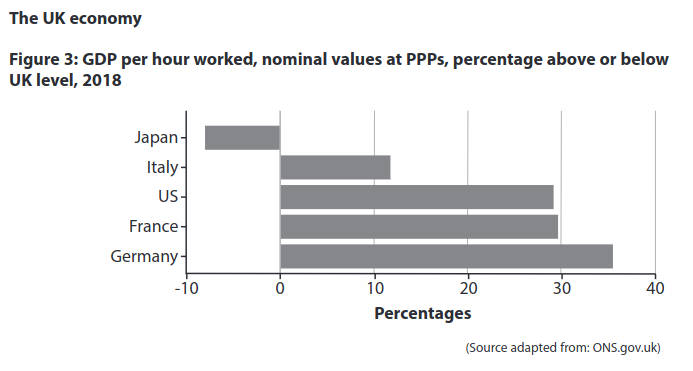
(a) With specific reference to Figure 3, explain why productivity is measured by ‘GDP per hour worked, nominal values at PPPs’. (5 points)c
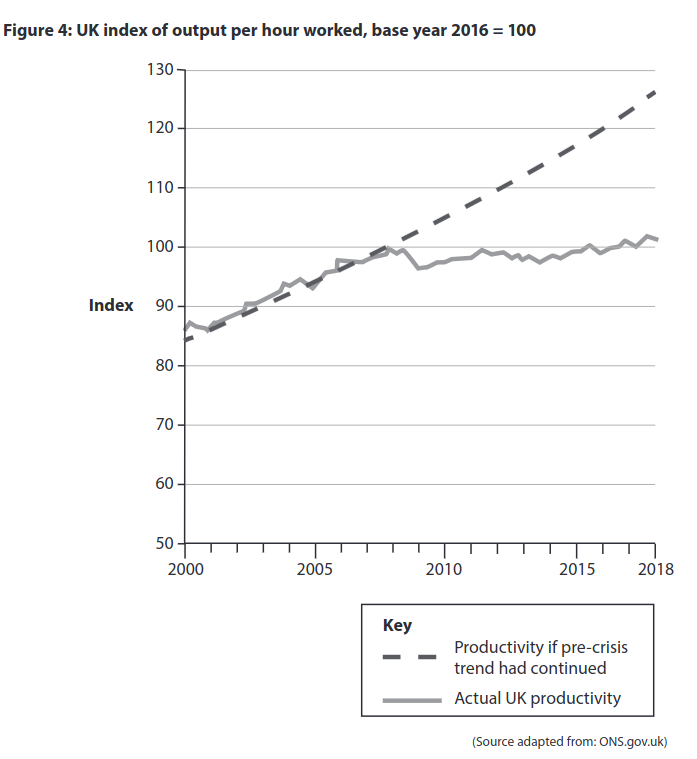
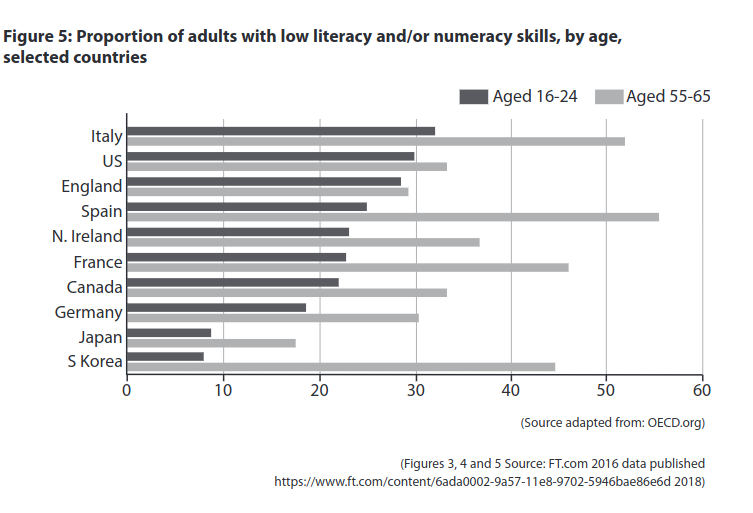
(b) Apart from literacy and numeracy skills in young workers, examine one reason for the trend in productivity in the UK, over the period shown in Figure 4. (8 points)
(c) Discuss factors that are causing many high street retailers in the UK to close some branches or shut down completely. Use a cost and revenue diagram to support your answer (12 points).
EITHER
(d) Evaluate possible microeconomic and macroeconomic policies which could be used to improve UK competitiveness. (25 points)
OR
(e) Evaluate the microeconomic and macroeconomic effects of a decline in the literacy and numeracy skills of a country’s young workers. (25 points)
Question 4: Edexcel A-Level Economics Paper 3 June 2023
Evaluate the microeconomic and macroeconomic effects of a depreciation of the pound. Refer to restaurants or other food delivery services in your answer (25 points).
Question 5: Edexcel A-Level Economics June 2023
Evaluate macroeconomic policies that could be used to increase international competitiveness in the UK’s export markets.
Question 6
Evaluate the likely impact of increased protectionism on the global economy (25 points).

Mark is an A-Level Economics tutor who has been teaching for 6 years. He holds a masters degree with distinction from the London School of Economics and an undergraduate degree from the University of Edinburgh.