This page contains a complete list of Edexcel A-Level Economics past paper questions on inequality, compiled from published Edexcel exam papers. All relevant questions are gathered in one place to help you revise income, wealth, and opportunity inequality efficiently, with an answer key available at the end of the page.
This page forms part of our full Edexcel question bank: Edexcel A-Level Economics past paper questions by topic . When revising inequality, it is especially useful to pair this topic with economic development, the labour market, and government debt, spending, and taxation.
What is Edexcel A-Level Economics?
Edexcel A-Level Economics is a UK pre-university qualification taken by students in Years 12 and 13. It assesses understanding of core microeconomic and macroeconomic concepts and the ability to apply economic analysis to real-world policy issues.
For full syllabus coverage, see the main hub: Edexcel A-Level Economics past paper questions.
How did we find these inequality questions?
We reviewed Edexcel A-Level Economics past papers and extracted every question that directly tests income inequality, wealth inequality, or inequality of opportunity. The aim is to provide a single, efficient resource so you can practise exam-style questions without having to search through multiple papers.
Within the Edexcel specification, inequality is most often assessed in Theme 4 contexts and frequently overlaps with questions on economic growth and development and fiscal policy.
What is inequality?
In Edexcel A-Level Economics, inequality refers to differences in income, wealth, and economic opportunity between individuals or groups within a society. The course focuses primarily on income and wealth inequality and how these affect living standards and economic outcomes.
Several factors can increase inequality, including differences in education and skills, labour market outcomes, access to finance, discrimination, and uneven effects of economic growth. In many cases, economic growth can initially widen inequality if higher-income or better-educated groups benefit disproportionately.
The three main types of inequality assessed at A-Level are:
- Income inequality – differences in wages and earnings between individuals or groups, often influenced by skills, education, and labour market conditions.
- Wealth inequality – differences in the ownership of assets such as property, savings, and investments, minus liabilities.
- Inequality of opportunity – unequal access to education, healthcare, employment, and social mobility.
Exam questions on inequality often require evaluation of policy responses, including taxation, welfare spending, education investment, and labour market reforms.
Question 1: Edexcel A-Level Economics 9EC0 November 2020 Paper 2
In terms of income distribution and wealth distribution, Brazil is one of the most unequal countries in the world. Its income Gini coefficient is 0.449 and it is ranked number 2 in the world for its wealth inequality. Evaluate possible economic causes of income and wealth inequalities within a country such as Brazil. (25 points).
Question 2: Edexcel A-Level Economics 9EC0 May 2019 Paper 2
According to the charity Oxfam, the combined wealth of the 62 richest people in the world is the same as the wealth of the poorest half of the world’s population. The value of the combined wealth of the poorest half of the world’s population has fallen by 38% between 2010 and 2016.
(a) Explain the distinction between income and wealth. (2 points)
(b) Explain one likely reason why global wealth inequality has increased. (2 points)
(c) Which one of the following would be most likely to reduce a country’s Gini coefficient?
An increase in: (1 point)
A import tariffs
B progressive taxes
C regressive taxes
D value added tax
Question 3: Edexcel A-Level Economics 9EC0 June 2017 Paper 2
The chart below shows the UK Gini coefficient of incomes, 2007 to 2013.
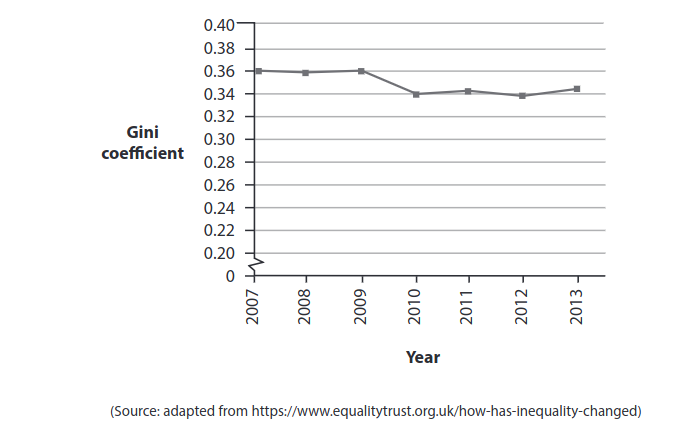
(a) Explain one likely reason for the change in UK income inequality since 2007. (4 points)
(b) Which one of the following values for the Gini coefficient is correct if there is perfect income equality? (1 point)
A 0
B 0.5
C 1
D 50:50
Question 4: Edexcel A-Level Economics 9EC0 June 2023 Paper 3
Evaluate the microeconomic and macroeconomic effects of falling house prices (25 points).
Question 5: Edexcel A-Level Economics June 2023 Paper 3
Evaluate the microeconomic and macroeconomic policies that could be used to reduce inequality in the UK (25 points).

Mark is an A-Level Economics tutor who has been teaching for 6 years. He holds a masters degree with distinction from the London School of Economics and an undergraduate degree from the University of Edinburgh.