This page contains a complete list of Edexcel A-Level Economics 25-Markers on Microeconomics, compiled from published Edexcel exam papers. These questions represent the most demanding assessment type in the Edexcel exam, requiring sustained analysis, evaluation, and clear judgement to achieve full marks.
This page is part of our wider Edexcel question bank: Edexcel A-Level Economics past paper questions by topic. If you are revising microeconomics at topic level, you may also want to practise questions on market structures, externalities, and the labour market.
What is the Edexcel A-Level Economics test?
Edexcel A-Level Economics is a UK pre-university qualification taken by students in Years 12 and 13. It assesses understanding of microeconomic and macroeconomic theory and the ability to apply economic reasoning to real-world contexts.
For full coverage of the specification, see the main hub: Edexcel A-Level Economics past paper questions. You can find all the Edexcel A-Level Economics Past Papers via the link.
How did we compile these Edexcel A-Level Economics 25-Markers on Microeconomics?
We reviewed Edexcel A-Level Economics past papers and extracted every 25-marker that primarily tests microeconomic concepts. The aim is to provide a single resource where you can practise extended-response questions without searching through multiple exam papers.
These questions frequently draw on concepts from business costs and revenue, indirect taxes and subsidies , and market power and competition.
What is microeconomics?
Microeconomics studies how individual consumers, workers, and firms make decisions, and how these decisions affect prices, output, and resource allocation in individual markets.
In Edexcel A-Level Economics, microeconomics includes topics such as supply and demand, elasticity, externalities, market structures, labour markets, government intervention, and information gaps. Microeconomic questions typically focus on welfare outcomes, efficiency, and trade-offs between competing objectives.
Unlike microeconomics, which examines economy-wide outcomes such as inflation and economic growth, microeconomics focuses on specific markets and decision-makers.
How to answer Edexcel Microeconomics 25-markers?
Answer A-Level Economics 25-Markers on Microeconomics by writing four body paragraphs (two analyses and two evaluations) that answer directly the question you’ve been asked and which meet the criteria to score 4 knowledge points, 4 application points, 8 analysis points, and 9 evaluation points. The main difference between writing an Edexcel Economics 25-marker and a 12 or 8-marker is that you are expected to do more in each of the four marking criteria and should separate out your evaluation points from your analysis points so that you can develop them fully.
You should also try to use diagrams whenever suitable in order to secure more analysis points and, where possible, introduce your own real-world examples to strengthen your arguments. You should treat your separate evaluation points as if they were analysis arguments and introduce evidence from the extracts and linked development (A → B → C) whenever possible. Edexcel 25-markers should include an introductory paragraph that offers core definitions as well as a conclusion or “final judgement” paragraph at the end that brings together your two evaluation paragraphs into an overall answer to the question you were asked.
How are A-Level Economics 25-Markers on Microeconomics graded?
All A-Level Economics 25-Markers on Microeconomics are marked based on whether you secure 4 knowledge points, 8 analysis points, 4 application points, and 9 evaluation points. You can secure 4 knowledge points by offering 2 relevant definitions and 2 factors that influence the answer to your question.
Expect as a rough guide that each factor or definition will secure you 1 knowledge point and you are looking to rack up 4 in total. Introduce your definitions in your “introduction” paragraph. You can secure 8 analysis points by offering 4 instances of chained analysis. As you are looking for 4 analysis points within each argument, you will want to offer a more sophisticated chain of analysis than in an 8-marker.
You can do this by offering three steps in your chain A→ B → C so that you not only explain the immediate cause of an outcome but also a further consequence of that outcome. For example, increasing cigarette prices will reduce consumption → this will reduce health risks → this will reduce the burden on the public healthcare system and/or increase worker productivity.
Try to offer an example of chained analysis in each of your analysis paragraphs and each of your evaluation paragraphs for 4 total instances of chained analysis and 8 points in total. You can secure 4 application points by pulling 4 data points from the extracts that support your argument. For example, data on the number of cigarette-related health risks would support the argument about indirect taxes eliminating this externality.
Finally, you can secure 9 evaluation points by fully explaining one counterargument for each of the two points you offer in your answer. These two points of evaluation should be given a full separate paragraph so you can dedicate enough space to explaining them completely. Look to include data points from the extracts or your own real-world examples where possible. You will also want to secure evaluation points in your conclusion or “final judgement.” You should offer a conclusion that brings together your two previous points of evaluation. A simple way to do this is to tell the marker which of your two arguments you find most compelling.
Question 1: Edexcel A-Level Economics 9EC0 November 2021 Paper 1
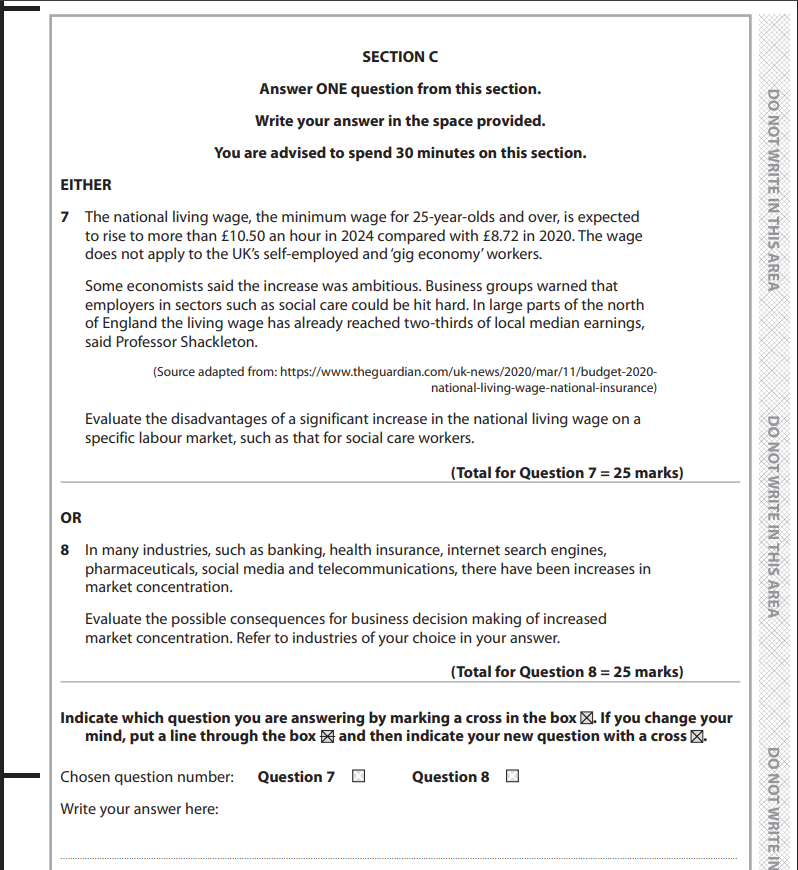
The national living wage, the minimum wage for 25-year-olds and over, is expected to rise to more than £10.50 an hour in 2024 compared with £8.72 in 2020. The wage does not apply to the UK’s self-employed and ‘gig economy’ workers.
Some economists said the increase was ambitious. Business groups warned that employers in sectors such as social care could be hit hard. In large parts of the north of England the living wage has already reached two-thirds of local median earnings, said Professor Shackleton.
Evaluate the disadvantages of a significant increase in the national living wage on a specific labour market, such as that for social care workers. (25 points)
Question 2: Edexcel A-Level Economics 9EC0 November 2021 Paper 1
In many industries, such as banking, health insurance, internet search engines, pharmaceuticals, social media and telecommunications, there have been increases in market concentration.
Evaluate the possible consequences for business decision-making of increased market concentration. Refer to the industries of your choice in your answer. (25 points)
Question 3: Edexcel A-Level Economics 9EC0 November 2020 Paper 1
The International Energy Agency has predicted that oil use by cars will peak in 2025 because of the increasing number of drivers switching to electric vehicles.
Evaluate the likely microeconomic consequences of consumers shifting from vehicles powered by fuel obtained from oil to electric-powered vehicles. (25 points)
Question 4: Edexcel A-Level Economics 9EC0 November 2020 Paper 1
‘Amazon.com, the giant online retailer, has too much power.’ It uses its market power to put a squeeze on publishers, in effect driving down the prices it pays for books. If a publisher refuses, Amazon may take action by ‘delaying their delivery, raising their prices, and steering customers to other publishers’.
Evaluate the likely costs of a monopsony operating in a market such as book retailing. (25 points)
Question 5: Edexcel A-Level Economics 9EC0 June 2019 Paper 1
In July 2017 it was announced that only a third of the BBC’s 96 top earning presenters were women and that its seven highest-paid presenters were all men.
According to the High Pay Centre, in 2018, UK chief executives can earn 120 times more than the average full-time worker earning £28 758.
With reference to an industry of your choice, evaluate why wage differences exist within the UK labour market.
Question 6: Edexcel A-Level Economics 9EC0 June 2019 Paper 1
In October 2017 Scania, the Volkswagen-owned truck maker, was fined €880 million (£771 million) by the European Commission for colluding with five other truck manufacturers over a 14-year period. The firms had agreed to coordinate prices after experiencing additional costs of meeting emission regulations.
With reference to an industry of your choice, evaluate why some firms engage in collusive behaviour (25 points).
Question 7: Edexcel A-Level Economics 9EC0 June 2018 Paper 1
In September 2016 the government approved the building of an £18 billion nuclear power station, Hinkley Point C, which will supply 7% of UK electricity for up to 60 years. The power station is funded by Chinese and French investment. Evaluate the likely private costs and external costs involved in such major power station construction projects. Use an appropriate externalities diagram in your answer. (25 points)
Question 8: Edexcel A-Level Economics 9EC0 June 2018 Paper 1
In July 2016 Apple’s share of the UK market for smartphones was 38%. Evaluate whether such a high market share for one company is in the consumer interest. Use appropriate diagrammatic analysis in your answer. (25 points)
Question 9: Edexcel A-Level Economics 9EC0 June 2017 Paper 1
In 2015 a report by Public Health England recommended the imposition of a 20% tax on the sale of soft drinks that contain high levels of sugar. Evaluate the likely microeconomic effects of such a tax. (25 points)
Question 10: Edexcel A-Level Economics 9EC0 June 2017 Paper 1
Revenue maximisation is a more realistic business objective than profit maximisation for many businesses.’ To what extent do you agree with this statement? Refer to an industry of your choice in your answer. (25 points)
Question 11: Edexcel A-Level Economics 9EC0 Paper 1 2024
A small hotel in Scarborough has seen its energy bills increase from £2000 to £8000
per month. Small businesses do not have the energy management teams of larger
companies to negotiate better deals.
Evaluate the microeconomic effects of rising energy bills on the hotel industry or an
industry of your choice.
Question 12: Edexcel A-Level Economics 9EC0 Paper 1 2024
Bytedance, which owns TikTok, has launched its own fragrance ‘Emotif’.
The Beijing-based social media giant has already entered the food and drink markets.
Evaluate the level of contestability in the fragrance industry or another industry of
your choice.
Question 13: Edexcel A-Level Economics 9EC0 Paper 1 2023
The average UK household energy bill (gas and electric combined) rose 80% from
£1971 in 2021 to £3549 in 2022.
Evaluate possible methods of government intervention to control household energy
bills in the UK.
Question 14: Edexcel A-Level Economics 9EC0 Paper 1 2023
Using 2021 estimates of carbon emissions, it is estimated that a petrol car journey from London to Glasgow emits approximately 3.3 times more carbon dioxide per passenger than the equivalent journey by train.
Evaluate possible methods of government intervention to reduce carbon emissions caused by road transport in the UK.
Question 15: Edexcel A-Level Economics 9EC0 Paper 1 2022
Tesla held an 82% market share of the electric vehicle market in the United States
during the first half of 2020.
Evaluate whether a monopoly is likely to operate efficiently. Refer to at least one
monopoly of your choice.
Question 16: Edexcel A-Level Economics 9EC0 Paper 1 2022
Some occupations in the UK are facing large labour shortages. Hard-to-fill vacancies include qualified chefs, software engineers, construction workers and qualified nurses.
Evaluate the factors that might influence the supply of labour in an occupation of your choice.
Frequently Asked Questions (FAQs)
What microeconomics topics are covered by these 25 mark questions?
This collection includes 25 mark essay questions from across the Edexcel A-Level Economics microeconomics specification. Topics include demand and supply, price elasticity, market failure, government intervention, labour markets, market structures, business growth, competition policy, and inequality.
Are these questions organised by microeconomics topic?
Yes. The questions are grouped into individual microeconomics topics, making it easier to focus your revision on weaker areas or practise essays alongside each section of the specification.
Why should I practise past paper 25 mark microeconomics questions?
Past paper questions show you exactly how Edexcel assesses evaluation, analysis, and application in the final exam. Practising genuine exam questions helps you become familiar with the style, depth, and structure expected in high-mark responses.
Which microeconomics topics appear most frequently in 25 mark questions?
Topics such as market failure, government intervention, market structures, labour markets, and business behaviour regularly feature in Edexcel 25 mark essays. However, students should be prepared for questions from any part of the microeconomics specification.
Can I use these questions for timed essay practice?
Yes. These questions are ideal for completing under exam conditions. Setting yourself a time limit and marking your work against the official mark scheme is one of the best ways to improve essay-writing skills.
Do I need to draw diagrams in a 25 mark microeconomics essay?
Many microeconomics essays benefit from accurate diagrams, such as supply and demand, externalities, monopoly, or labour market diagrams. While diagrams alone do not earn many marks, they can strengthen your analysis when they are accurate, labelled, and clearly explained.
What skills are assessed in Edexcel microeconomics 25 mark questions?
These essays assess your ability to apply economic theory to real-world contexts, develop logical chains of analysis, evaluate different viewpoints, and reach well-supported judgements based on the evidence provided in the question.
Are these questions useful for teachers and tutors?
Yes. Teachers, tutors, and students can use this collection to plan lessons, assign homework, create mock exams, or provide targeted essay practice for specific microeconomics topics.
Should I revise the content before attempting these questions?
It is generally helpful to understand the underlying theory before attempting a 25 mark essay. Once you have revised a topic, completing several past paper questions is one of the most effective ways to test your understanding and improve exam technique.
Is this collection updated when new Edexcel microeconomics papers are released?
Yes. Whenever new official Edexcel A-Level Economics papers become available, this page is updated with any new microeconomics 25 mark essay questions so that you have access to the latest exam material.

Mark is an A-Level Economics tutor who has been teaching for 6 years. He holds a masters degree with distinction from the London School of Economics and an undergraduate degree from the University of Edinburgh.